


24 Sep 2026
CNC Precision Machining for Robot Components
Materials, Tolerances & Applications
A practical guide to how precision CNC machining supports the performance, accuracy, and reliability of industrial and collaborative robots.
|
Introduction
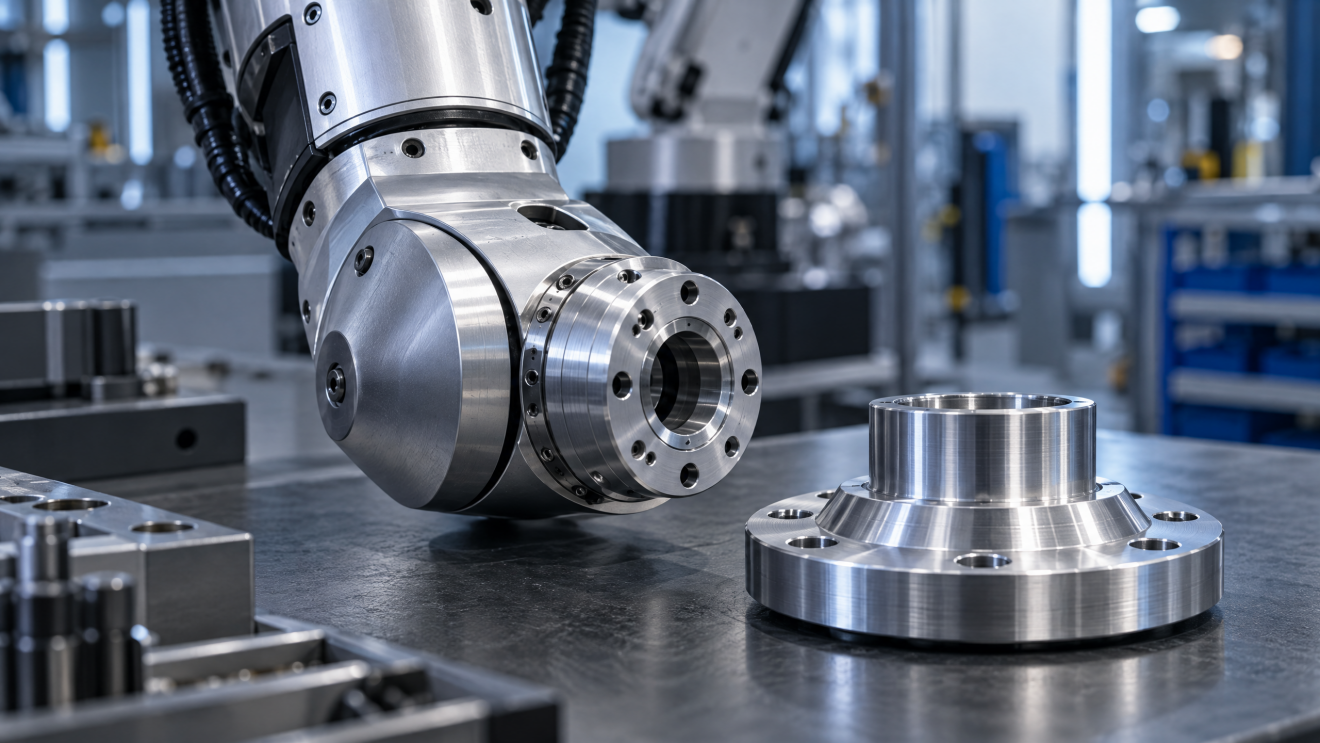
As industrial and collaborative robots become more common across manufacturing, the demand for tighter tolerances, lighter structures, and more repeatable performance keeps rising. Behind every reliable robot is a set of precisely machined components—and CNC precision machining has become the manufacturing method of choice to meet these demands. This guide walks through the robot components that rely on CNC machining, the materials used, the tolerances that matter, and what to look for in a manufacturing partner. At Hotarc CNC, this is our core focus — we manufacture precision robot components to tolerances as tight as ±0.002 mm.
1. Common Robot Components That Require CNC Machining
A robot's body is made up of dozens of precision parts working together. The most common ones include:
▸ Joint structural parts — the core mechanisms connecting each robot axis, directly affecting motion accuracy
▸ Reducer housings — house harmonic or RV reducers; require extremely tight roundness and concentricity
▸ Links and arm structures — the main body of the robot arm, balancing strength and weight
▸ Flanges — connect motors, reducers, and arm sections; demand precise flatness and hole positioning
▸ Servo motor mounts — must maintain concentricity for repeatable positioning
▸ End-effector components — grippers and tool-flange interfaces that determine end-of-arm accuracy
|
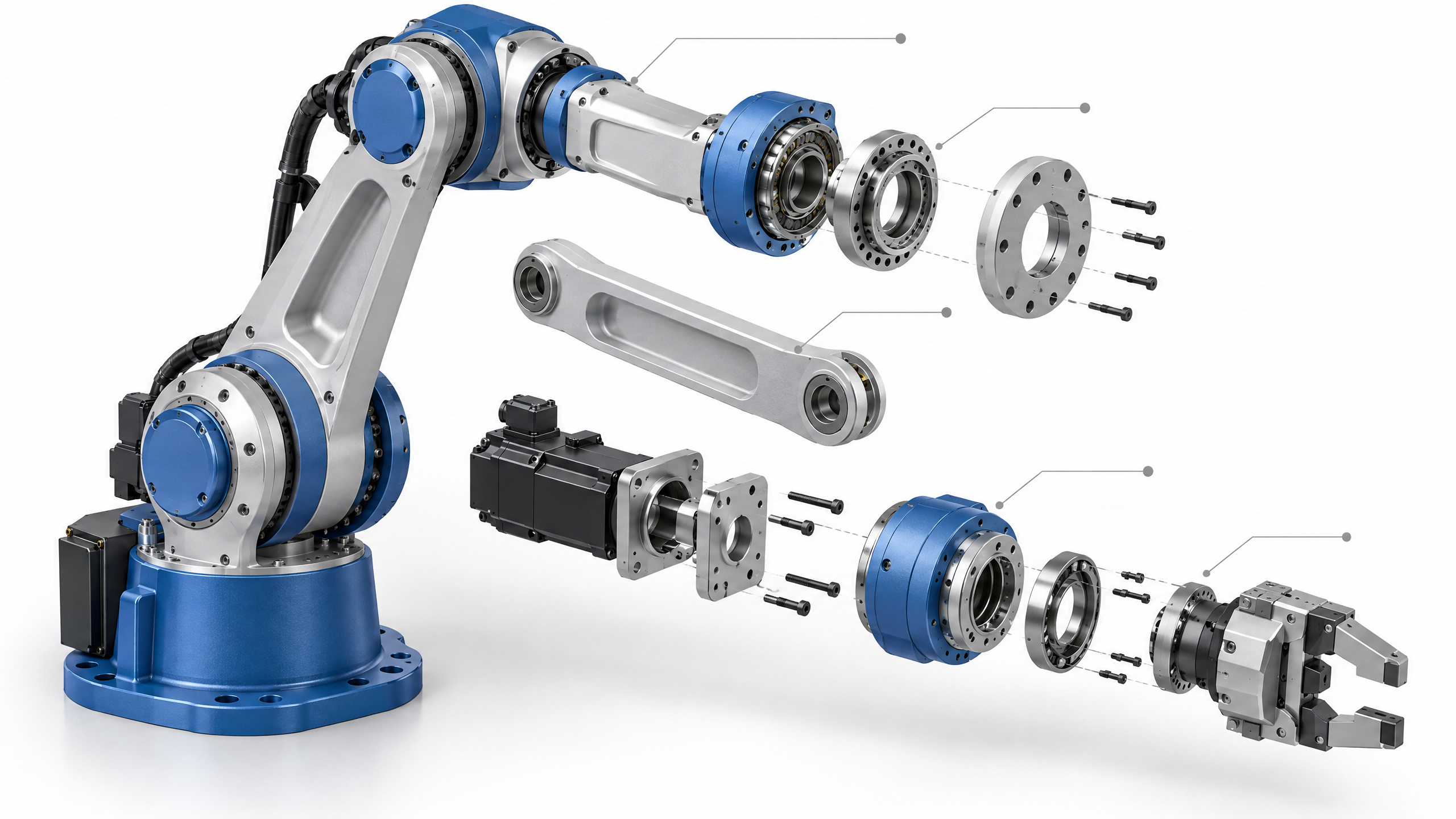
We manufacture all of the components above in-house. Browse our robot component capabilities to see materials, finishes, and lead times. |
2. Why Robot Components Demand CNC Precision Machining
Robots place stricter demands on their components than most mechanical equipment for three main reasons:
Tight-tolerance fits
Multiple parts must mate precisely at each joint—even small dimensional deviations compound across the kinematic chain and degrade end-of-arm accuracy.
Lightweighting
Robot arms need to be as light as possible without sacrificing strength, to reduce inertia and improve response speed. This drives careful material selection and structural design.
Repeatable positioning
Industrial robots typically require repeatability of ±0.02 mm or tighter—a standard that depends on the consistency of every individual machined part.
CNC machining, with its computer-controlled repeatability, is the manufacturing process best suited to consistently meet these requirements.
3. Materials Commonly Used in Robot Components
Material | Key Properties | Typical Use |
Aluminum alloys (6061, 7075) | Lightweight, machinability, cost-effective | Arm structures, flanges |
Stainless steel | High strength, corrosion resistant | Joint connectors, exposed structural parts |
Titanium alloys | Exceptional strength-to-weight ratio | High-end / aerospace-grade robot arms |
Engineering plastics (POM, PEEK) | Self-lubricating, insulating | Select transmission parts, housings |
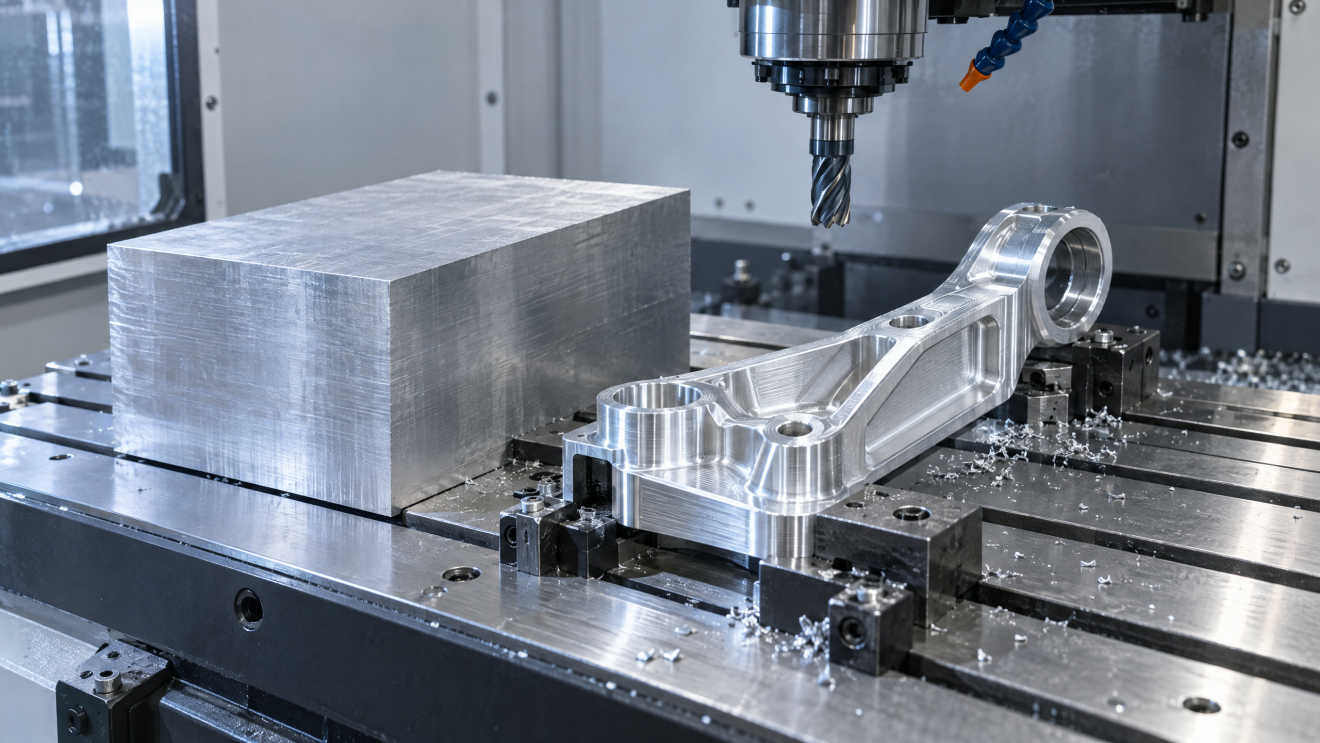
Aluminum alloys remain the most widely used material for robot arm structures and links, thanks to their favorable strength-to-weight ratio and machinability.
|
4. Precision and Tolerance Control
Tolerances on robot components are typically much tighter than on general mechanical parts. Key areas that require special attention include:
▸ Bearing seat tolerances — directly affect joint rotation smoothness and service life
▸ Reducer mounting face concentricity — deviations can cause noise, accuracy loss, or premature reducer failure
▸ Gear/spline fit precision — affects the smoothness of power transmission
Our capability Core robot components generally require dimensional tolerances in the ±0.01–0.02 mm range, with some critical mating surfaces held even tighter. At our facility, we routinely hold tolerances as tight as ±0.002 mm on critical features—well within the range needed for demanding robot joint and reducer-mounting applications. |
5. Surface Finishing Options
Post-machining surface treatments improve wear resistance, corrosion resistance, and appearance:
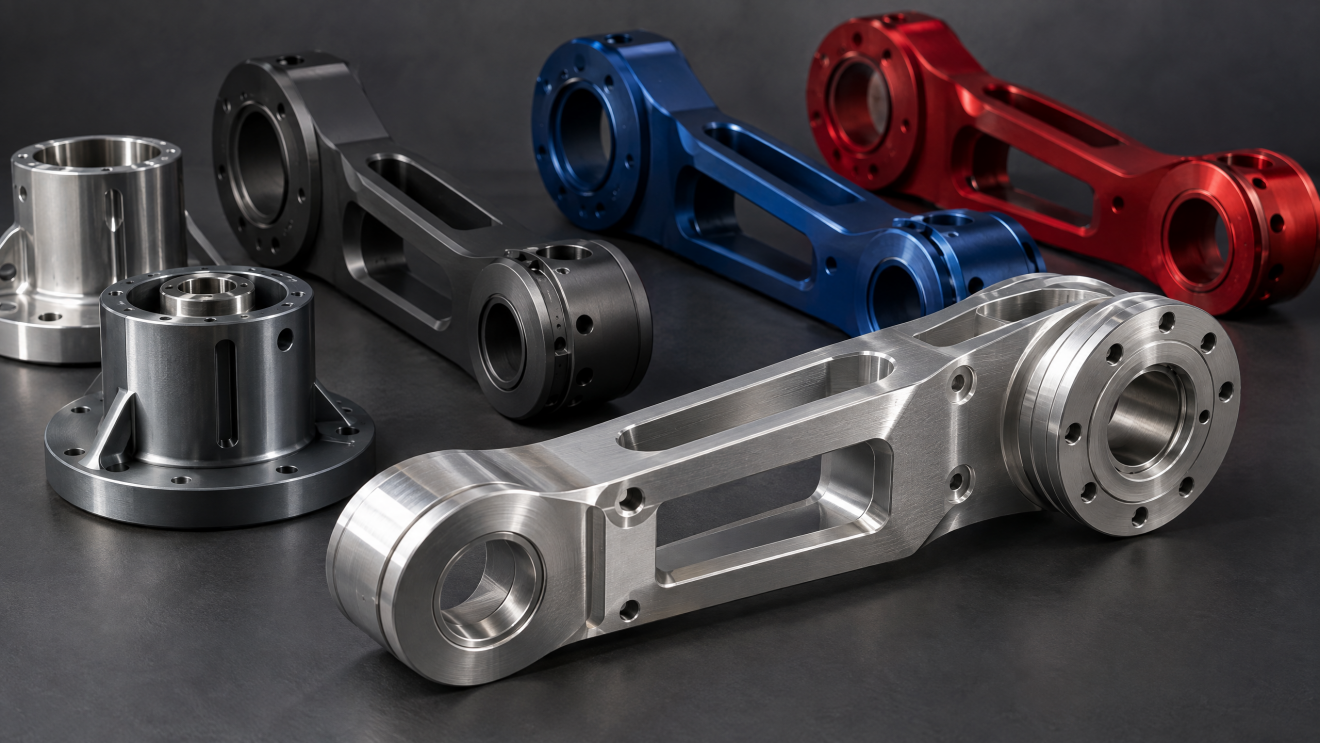
▸ Anodizing — for aluminum parts, improves wear and corrosion resistance and allows color options
▸ Hard anodizing — increases surface hardness for high-friction moving parts
▸ Plating / passivation — for stainless steel parts, enhances corrosion resistance
▸ Bead blasting / polishing — improves surface appearance on exposed structural parts
|
6. Beyond Robotics: Broader CNC Precision Applications
The same machining expertise and tolerance control used for robot components also supports precision parts for automotive, electronics, and medical device applications—giving manufacturers the flexibility to serve related industries with shared processes and quality standards.
7. How to Choose a Robot Component Machining Partner
When evaluating a CNC machining supplier for robot parts, consider:
▸ Equipment and process capability — multi-axis machining centers for complex geometries and tight-tolerance holes
▸ Quality inspection — CMM (coordinate measuring machine) capability for precision verification
▸ Prototyping and low-volume support — fast turnaround for R&D-stage sampling
▸ Production consistency — reliable quality and lead times at volume
Looking for a CNC machining partner for robot components? We specialize in precision-machined robot parts—holding tolerances as tight as ±0.002 mm—from prototyping to volume production, alongside broader CNC capabilities for automotive, electronics, and medical applications. Visit hotarcnc.com to see our full capabilities, or get in touch to discuss your drawings and requirements. |
Conclusion
As the robotics industry continues to grow, the precision and consistency of every machined component play a direct role in a robot's performance and reliability. Choosing an experienced CNC precision machining partner is a critical step toward building robots that perform accurately, day after day.
Hotarc CNC manufactures precision robot components to tolerances as tight as ±0.002 mm, alongside broader CNC machining for automotive, electronics, and medical applications. Explore our full range at www.hotarcnc.com.