


28 Sep 2026
How to Choose the Right CNC Machine for High-Precision Manufacturing
In high-precision manufacturing, the CNC machine sets the ceiling for part quality. Tolerances of a few microns, clean surface finishes, and consistent results from the first part to the ten-thousandth all depend on choosing equipment that fits your parts, materials, and production volume.
This guide covers the factors that matter most when selecting a CNC machine for tight-tolerance work, and how to verify that the machine delivers what the brochure promises.
1. Define Your Parts Before Comparing Machines
Start with the work, not the specification sheet:
• Part size and geometry: Work envelope, table load, and feature complexity all narrow the field quickly.
• Tolerance targets: A part held at ±0.05 mm needs a very different machine than one held at ±0.005 mm or tighter.
• Materials: Aluminum, stainless steel, carbon steel, brass, and engineering plastics such as POM and PEEK each place different demands on spindle speed, rigidity, and cooling.
• Production mode: Prototyping and small batches favor flexibility and fast setup. Mass production favors stability, automation, and low cycle times.
• Industry: Robotics, automation, medical, aerospace, and new energy parts often require documented and traceable quality, not just accurate dimensions.
2. Pick the Right Axis Configuration
• 3-axis: Cost-effective for prismatic parts, plates, and housings with features on one or two sides.
• 4-axis: Adds a rotary axis for cylindrical features and multi-face machining.
• 5-axis (simultaneous): Reaches complex 3D curves and multi-angle features in a single clamping, which reduces setup errors.
Fewer setups mean less stacking error. This is one of the most effective ways to improve accuracy on complex parts such as robot joint housings and structural components. If your future work may need 5-axis, a machine that is pre-wired and expandable can be a practical way to invest step by step.
3. Look Closely at the Spindle
The spindle affects both finish quality and tool life. Compare:
• Speed range: High-speed spindles suit aluminum and small-tool finishing. Higher torque suits steels.
• Taper and size: A smaller taper such as BT30 is quick to accelerate and change tools, which suits small and medium precision parts. Larger tapers suit heavy cutting.
• Cooling method: Oil-cooled spindles help control thermal growth, keeping precision stable during long runs.
For small precision components, a fast-acceleration, thermally controlled spindle is often the better choice than a bigger, heavier one.
4. Prioritize Rigidity and Thermal Stability
Two machines with identical published accuracy can perform very differently after several hours of cutting. What separates them:
• Structure and guideways: Rigid casting and linear roller guides reduce vibration, which improves surface finish and dimensional consistency.
• Thermal management: Spindle cooling and thermal compensation limit drift as the machine warms up.
• Environment: A stable shop temperature helps every machine perform closer to its rating.
Ask suppliers for repeatability data over a full shift, not only for a cold machine.
5. Understand Accuracy vs. Repeatability
Positioning accuracy tells you how close the machine gets to a commanded point. Repeatability tells you how consistently it returns there. For batch production, repeatability is often the more important figure, because it determines whether part number 1 matches part number 1,000.
As a reference point, our production uses Japan Brother S1000X1 SPEEDIO machining centers, which deliver stable repeatable precision of ±0.002 mm. That level of consistency supports demanding parts such as robotic components, where mating surfaces, bearing seats, and mounting interfaces must fit reliably.
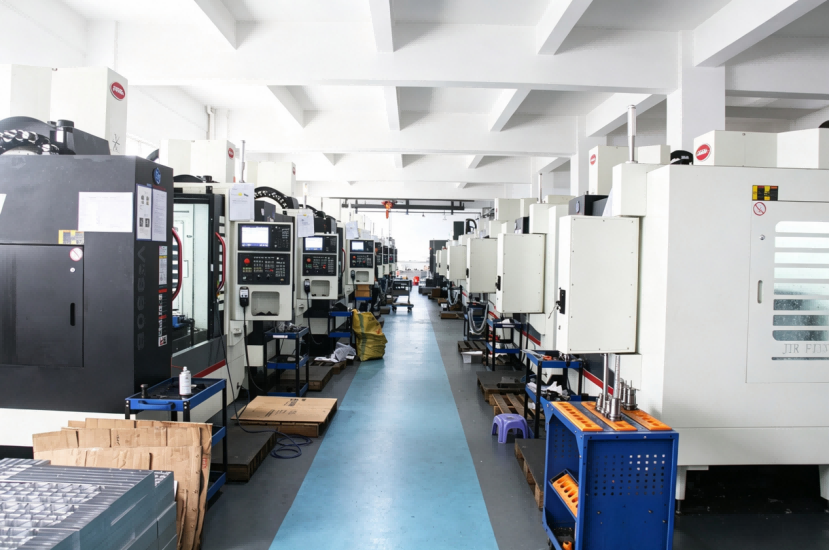
Our Brother SPEEDIO machining centers deliver stable ±0.002 mm repeatable precision.
6. Evaluate the Controller and Software
The controller shapes programming speed, surface quality, and operator workflow. Consider:
• Look-ahead and smoothing functions for better contouring
• Ease of programming and compatibility with your CAM system
• Probing and tool-measurement cycles for in-process checks
• Data output for traceability
A good controller also reduces dependence on operator skill, which is a common source of variation.
7. Plan Tooling, Workholding, and Automation
The machine is only part of the system. Precision also depends on:
• Workholding: Consistent, repeatable fixturing prevents clamping distortion and setup error.
• Tool magazine and tool management: More tool positions and fast changes reduce cycle time on complex parts.
• Automation readiness: Pallet systems, robot loading, or bar feeders help if you plan to scale.
8. Match the Machine to Your Materials
Confirm the machine has been proven on your actual materials. Aluminum rewards high speeds and good chip evacuation. Stainless steel needs rigidity and stable cutting conditions. Engineering plastics such as PEEK require sharp tooling and careful thermal control to avoid movement.
9. Build Inspection Into the Decision
A machine that cuts to tolerance is only useful if you can prove it. Verification is part of high-precision manufacturing, not an afterthought.
• CMM inspection: A 3D coordinate measuring machine can verify full dimensions and GD&T features such as position, flatness, and parallelism, which are impractical to check with hand tools.
• Controlled environment: A constant-temperature, anti-vibration lab keeps measurements reliable.
• Traceable reports: First article inspection, batch sampling, and final inspection with archived data give your customers confidence and support audits.
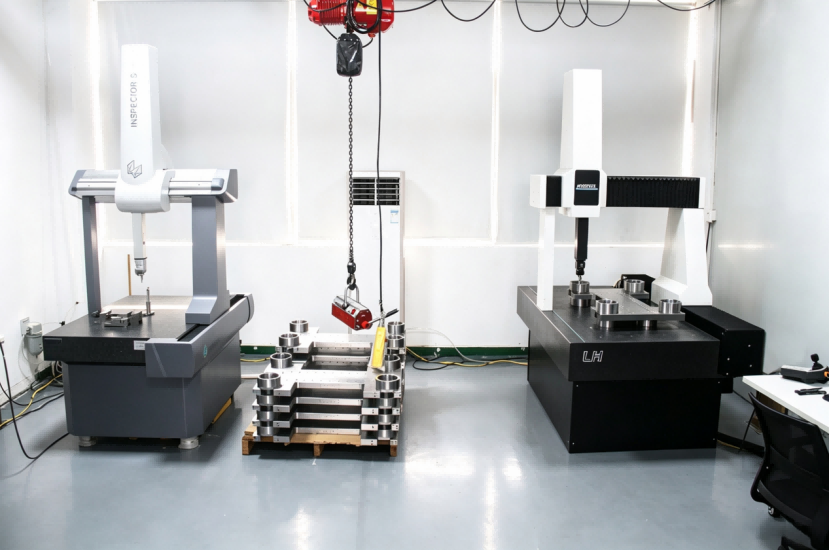
Dual CMM systems in our constant-temperature lab verify full dimensions and GD&T.
We follow a closed-loop process: precision machining, in-process checks, 3D full inspection, data verification, and then delivery. Whether you buy machines or outsource parts, look for the same loop.
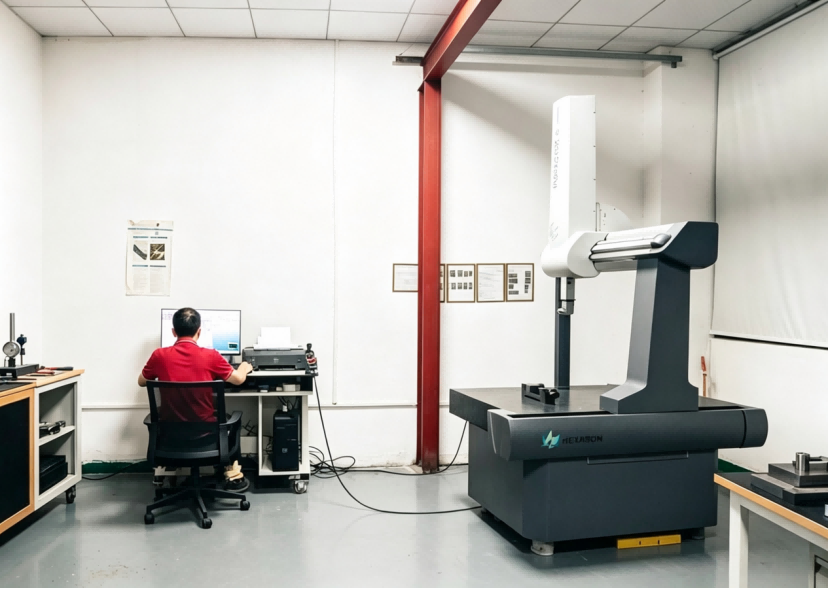
Every batch is measured and recorded, so inspection data stays traceable.
10. Consider Service and Total Cost of Ownership
Purchase price is only one part of the cost:
• Service and support: Downtime is expensive. Check response time and spare-parts availability.
• Training: Your team must be able to operate and maintain the machine well.
• Running costs: Tooling, energy, maintenance, and calibration add up over years.
• Scalability: Can the machine grow from prototypes to volume production?
Quick Selection Checklist
1. Define part size, material, tolerance, and volume.
2. Choose 3-, 4-, or 5-axis based on feature complexity.
3. Select a spindle with the right speed, taper, and cooling.
4. Confirm rigidity and thermal stability, not only headline accuracy.
5. Compare repeatability over long runs.
6. Check controller, CAM compatibility, and probing.
7. Plan workholding, tooling, and automation.
8. Build in CMM inspection and traceable reporting.
9. Compare total cost of ownership.
Conclusion
The right CNC machine is the one that matches your parts, your tolerances, and your production plan, and that sits inside a process where every dimension can be measured and proven. Machine, tooling, environment, and inspection work together to deliver consistent precision.
If you need high-precision CNC machined parts for robotics, automation, medical, aerospace, or new energy applications, our team can help with tight-tolerance machining and full inspection reports. Send us your drawings for a quote and engineering feedback.