


03 Nov 2026
CNC Machining vs 3D Printing vs Casting: Which Is Cheaper at Your Quantity?
There is no single cheapest manufacturing process. The right answer depends mostly on how many parts you need. Casting needs expensive tooling but makes cheap parts afterward. 3D printing needs no tooling but stays expensive per part. CNC machining sits in between, with no tooling and a cost per part that falls steadily as you order more.
This guide compares CNC machining, 3D printing, and casting by cost, quantity, tolerance, and lead time, with a simple break-even example and a decision guide you can use for your next project.
1. The Three Processes in Brief
• CNC machining: A subtractive process. Cutting tools remove material from solid stock to reach the final shape. It needs no tooling, holds tight tolerances, and works with a wide range of metals and plastics.
• 3D printing: An additive process. The part is built layer by layer from a digital file. It handles complex shapes and internal channels, but build time and material keep the cost per part high.
• Casting: Molten metal is poured into a mold. The mold or pattern is expensive to make, but once it exists, each part is inexpensive.
|
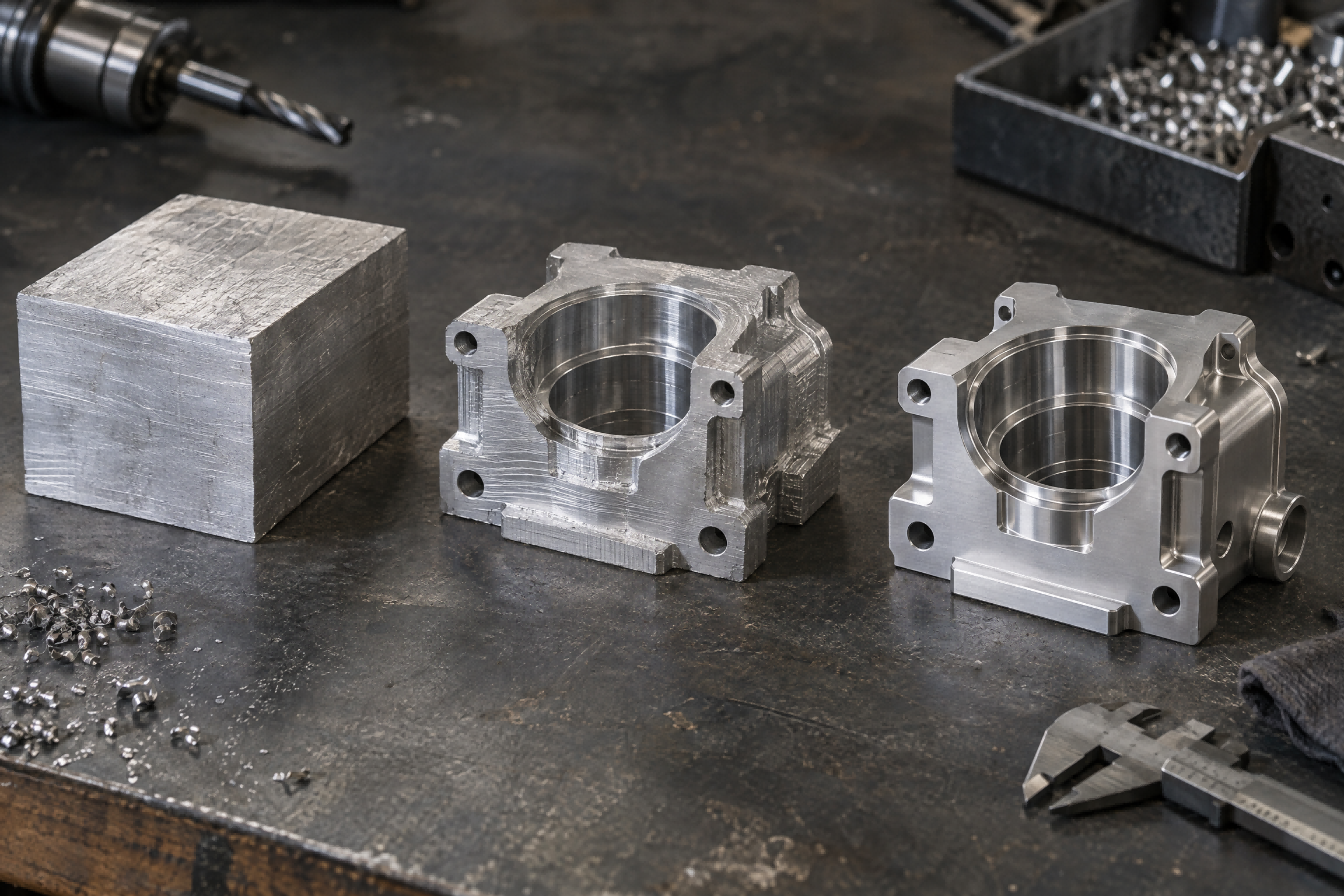
The same part at three stages: how much of the final precision comes from CNC machining.
2. Why Quantity Decides the Winner
The three processes have different cost structures. Casting has a large fixed cost and a small per-part cost. 3D printing has almost no fixed cost and a large per-part cost. CNC machining has a modest fixed cost, from programming and fixturing, and a moderate per-part cost.
CNC machining | 3D printing | Casting | |
Tooling cost | None | None | Mold or pattern required |
Setup cost | Programming and fixturing | File preparation | Tooling plus setup |
Cost per part | Moderate, driven by machining time | Higher, driven by build time and material | Low once tooling exists |
Cost curve | Falls moderately with quantity | Almost flat | Falls steeply with quantity |
Typical sweet spot | One piece to hundreds or thousands | One piece to a few parts | Hundreds to many thousands |
For a deeper look at how setup, material, and machining time build up a price, see our guide to CNC machining cost drivers.
3. A Break-Even Example
The numbers below are illustrative only. They are not quotes and will differ for real parts. The example assumes a simple metal part. CNC machining has a one-time setup of 120 and 35 per part. 3D printing has a setup of 30 and 50 per part. Casting has tooling of 6,000, a one-time machining setup of 120, and 27 per part, made up of 12 for casting and 15 for machining the critical features.
Unit price in illustrative units:
Quantity | CNC machining | 3D printing | Casting + finish machining |
1 piece | 155 | 80 | 6,147 |
10 pieces | 47.00 | 53.00 | 639.00 |
100 pieces | 36.20 | 50.30 | 88.20 |
1,000 pieces | 35.12 | 50.03 | 33.12 |
10,000 pieces | 35.01 | 50.00 | 27.61 |
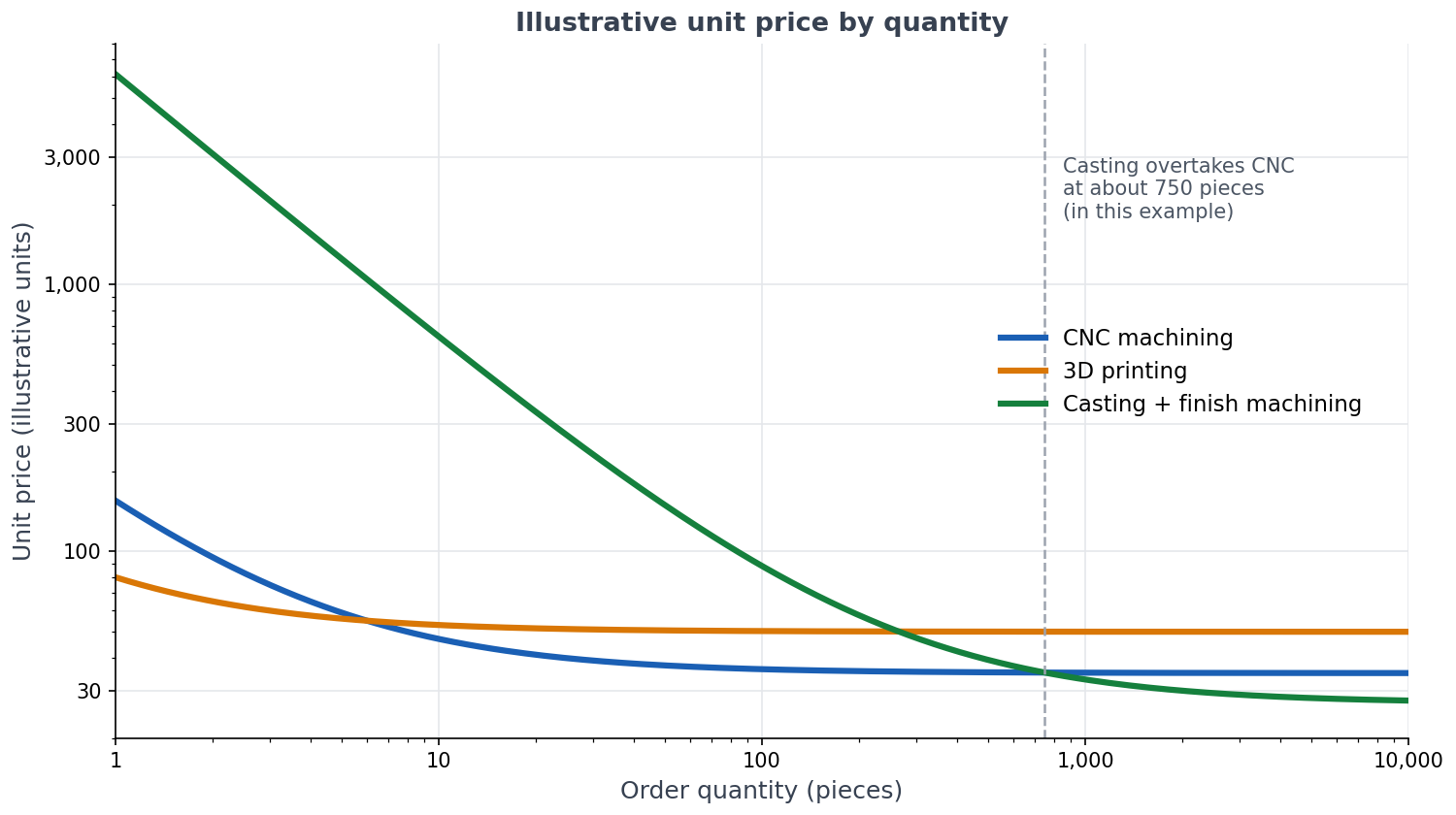
Illustrative unit price by quantity for the three processes.
What the example shows:
• At one to a few pieces, 3D printing is cheapest, because it has the lowest setup.
• From a handful of pieces up to several hundred, CNC machining is cheapest.
• Above roughly 750 pieces in this example, casting wins, because the tooling cost has been spread across many parts.
The crossover points move with the part. A larger, more complex part raises the machining cost and pushes the casting break-even lower. A simple small part does the opposite. Treat the numbers as a way to see the pattern, and get real quotes for your part.
4. Beyond Price: What Else Should You Compare?
Cost per part is only one factor. For precision parts, tolerance and finish often decide the process before price does.
Factor | CNC machining | 3D printing | Casting |
Typical as-produced tolerance | About ±0.01 mm or better; ±0.002 mm on suitable features | Roughly ±0.1 to ±0.3 mm | Roughly ±0.1 to ±0.5 mm or wider, depending on process and size |
Surface finish | Smooth machined surface | Rougher as built; often post-processed | Varies; often rougher than machined |
Materials | Wide range of metals and plastics | Limited to printable materials | Limited to castable alloys |
Time to first parts | Short, no tooling | Short, no tooling | Longer, tooling must be made first |
Design changes | Easy and cheap | Easy and cheap | Costly once tooling is made |
Geometry freedom | Limited by tool access | Very high, including internal channels | High, limited by mold design |
The tolerance figures above are typical as-produced values and vary with process, material, and part size. Our machining can hold ±0.002 mm on suitable features, which is why critical features on printed and cast parts are usually finished on a CNC machine.
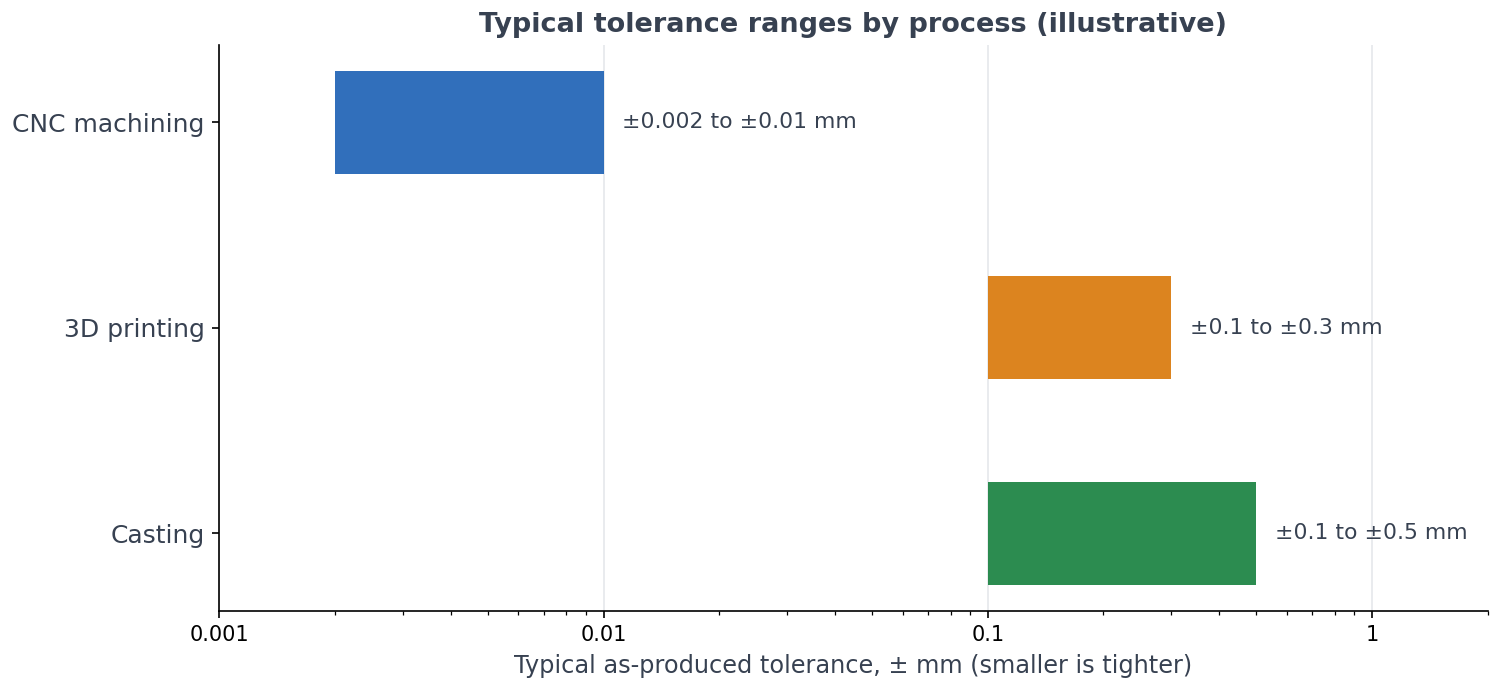
Typical as-produced tolerance ranges (illustrative). Smaller is tighter.
|
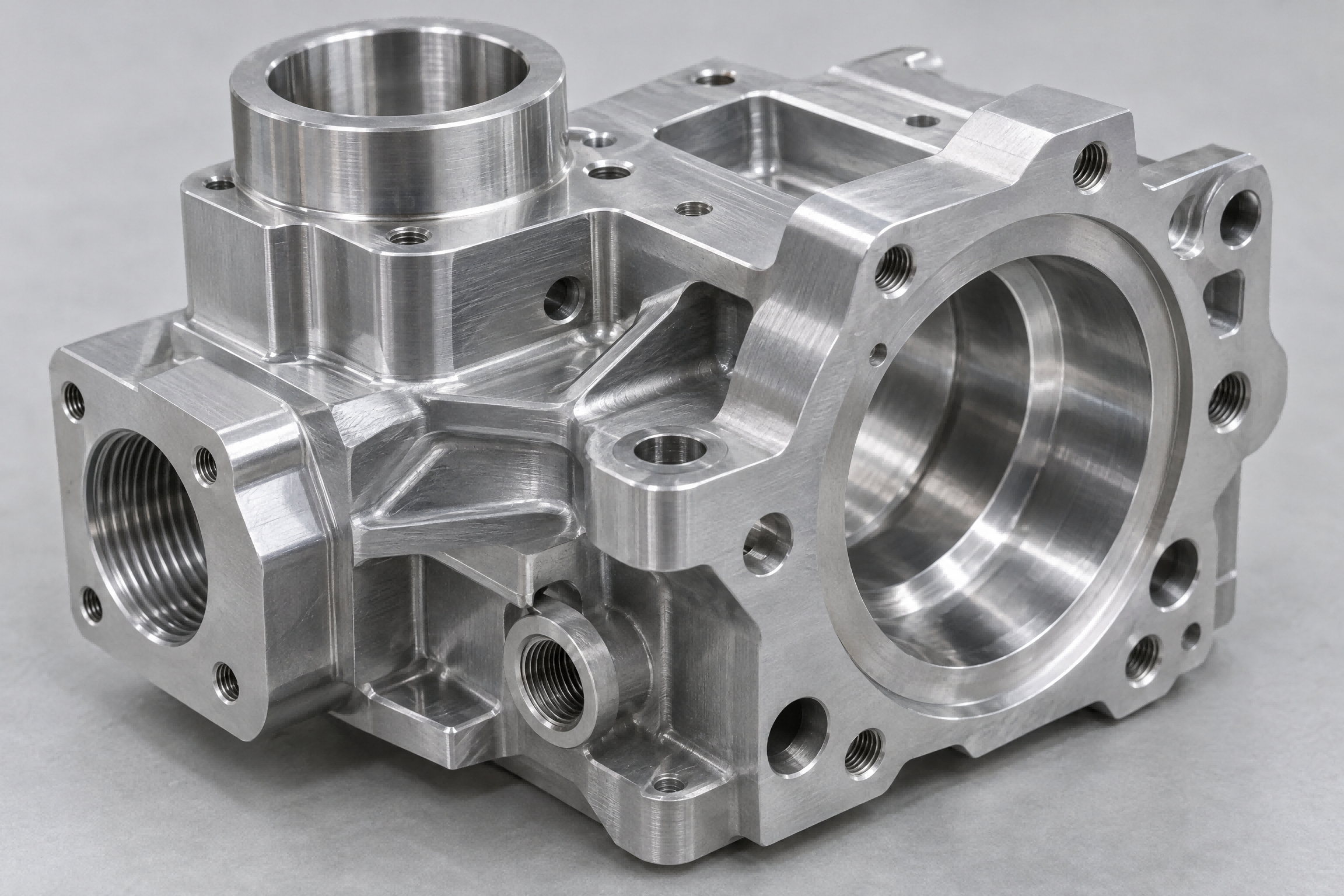
Bores, steps, and sealing faces are where CNC precision shows.
5. When Each Process Wins
CNC machining is usually the best choice when:
• You need prototypes or low to medium quantities.
• Tight tolerances or smooth machined surfaces matter.
• The design may still change, since there is no tooling to rework.
• You need a specific material or grade.
• You want a fast start without tooling lead time.
|
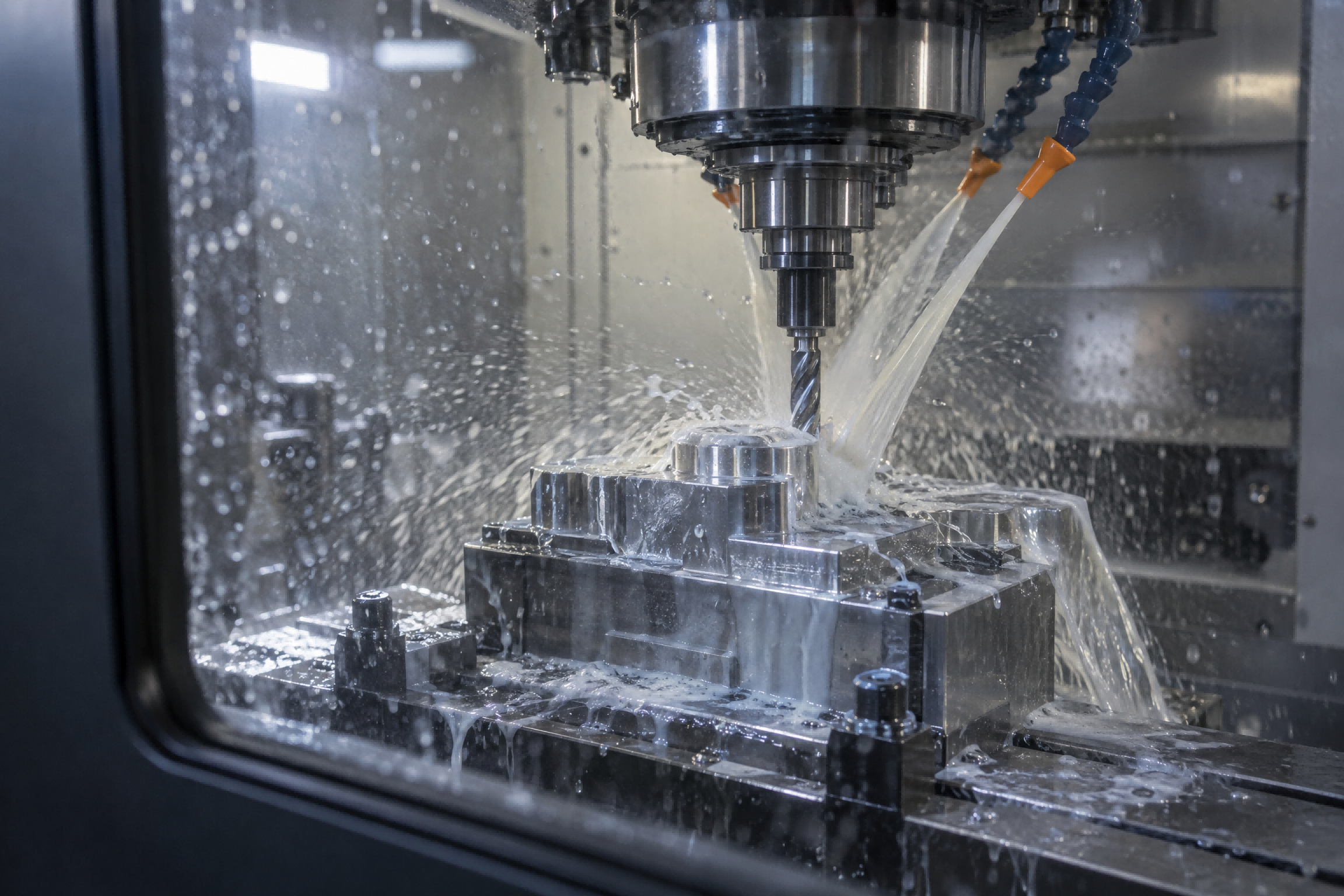
CNC machining needs no tooling, so cutting can start as soon as the program and fixture are ready.
3D printing is usually the best choice when:
• You need one or a few parts.
• The shape has internal channels, lattices, or geometry that cutting tools cannot reach.
• Tolerances are loose, or you plan to finish critical features afterward.
Casting is usually the best choice when:
• You need hundreds to thousands of identical parts.
• The design is stable, so the tooling investment is safe.
• The part shape suits a mold and the tolerance on most features is not tight.
6. Hybrid Approaches Often Win
In precision manufacturing, the processes are often combined instead of competing:
• Prototype with CNC machining or 3D printing, then move to casting once the design is frozen and volumes justify tooling.
• Make a near-net-shape blank by casting or 3D printing, then CNC machine bores, mounting faces, and threads to final tolerance.
• Use CNC machining for the early production run while tooling is being made, so parts ship without waiting.
Whatever makes the blank, features that mate with other parts are usually finished on a CNC machine to reach the required fit.
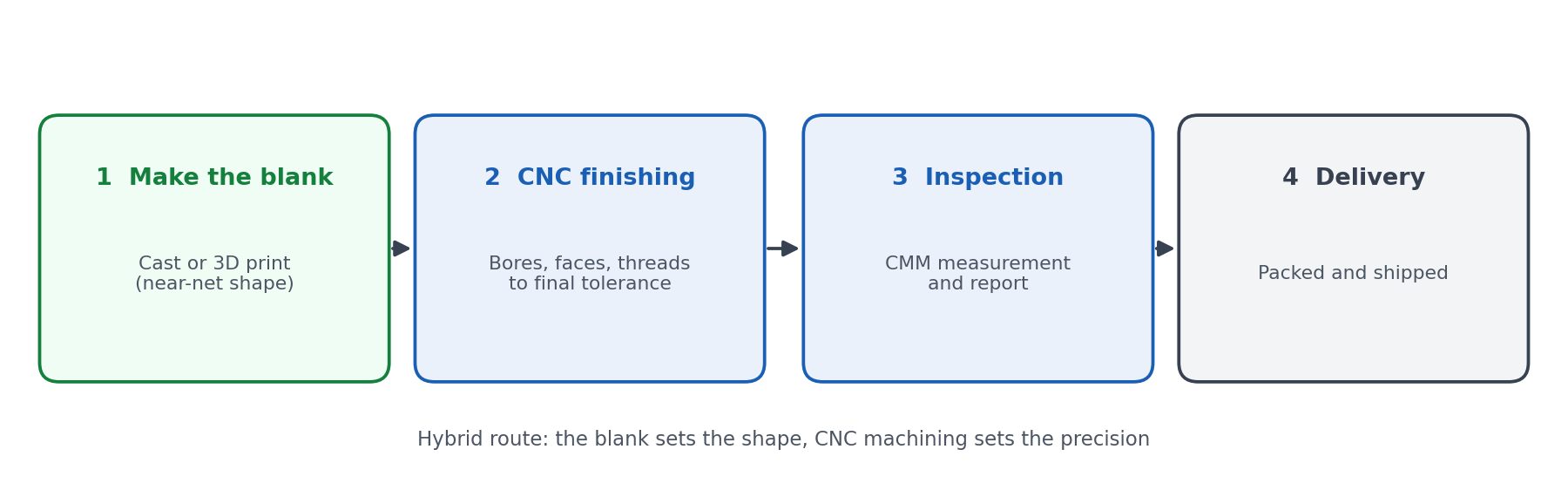
A common hybrid route: near-net blank, CNC finishing, inspection, delivery.
7. A Simple Decision Guide
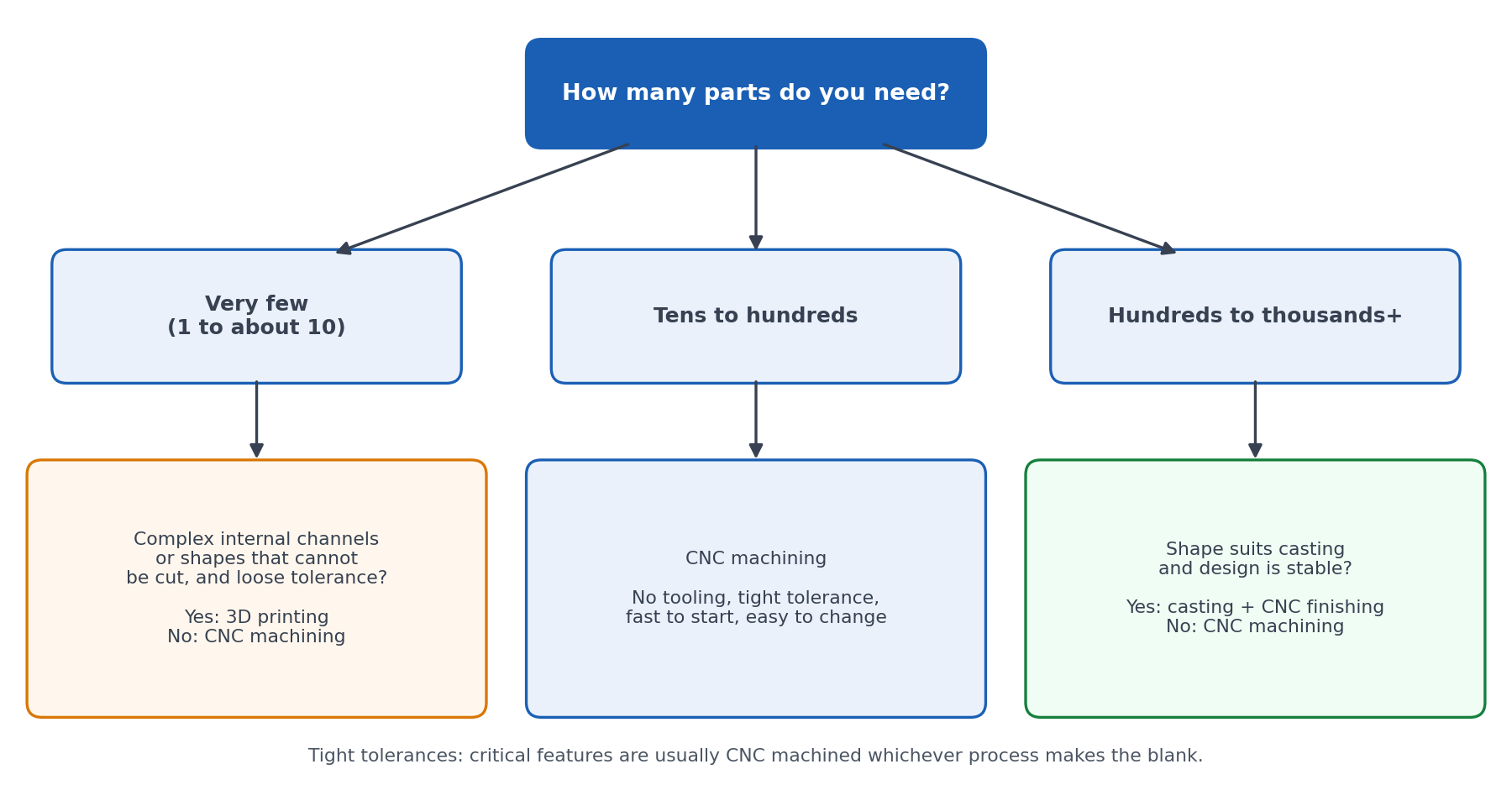
A quick guide to choosing a process by quantity and part type.
Use this as a starting point. If you are between two options, ask for quotes at several quantities so you can see where the curves cross for your own part.
8. Hidden Costs to Watch For
• Redesign for the process: A part designed for CNC may need changes for casting, such as draft angles and uniform wall thickness, which takes engineering time.
• Tooling changes: A design change after the mold is made can be expensive.
• Post-processing: Printed and cast parts often need machining, heat treatment, or finishing to meet the drawing.
• Inspection: Tight tolerances need measurement whichever process makes the part.
• Minimum order quantities: Casting suppliers often have minimums, so check them early.
Our design for manufacturability guide shows how to design CNC parts that cost less to machine.
|
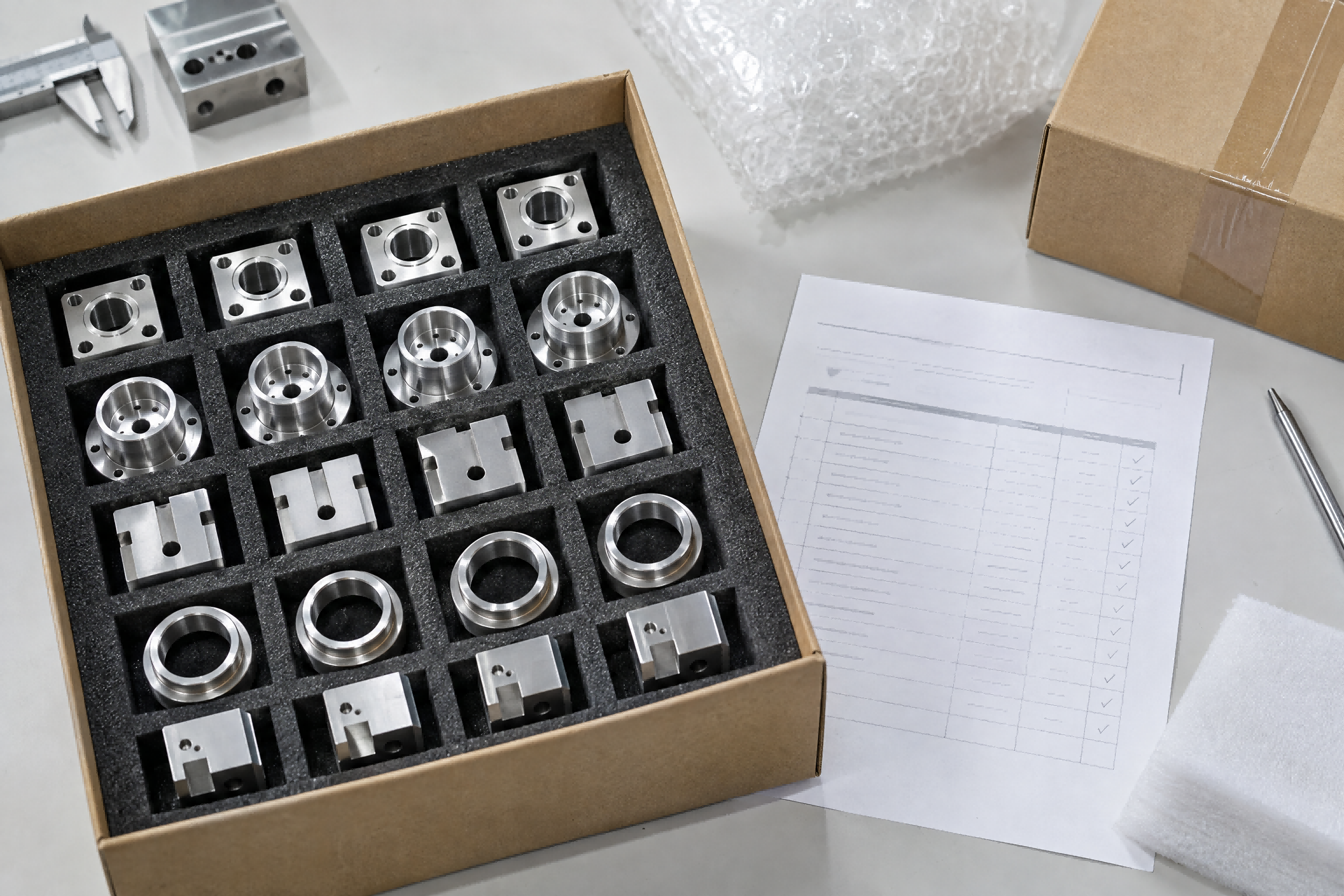
Packaging, labeling, and reports are part of delivering batch quantities.
Frequently Asked Questions
Is CNC machining cheaper than 3D printing?
For metal parts in quantities beyond a few pieces, CNC machining is often cheaper per part, and it usually gives tighter tolerances. 3D printing tends to win only for single pieces or shapes that cannot be machined.
At what quantity does casting become cheaper than CNC machining?
It depends on tooling cost and part size, but casting typically starts to pay off in the hundreds to thousands of pieces. A quote at several quantities shows the crossover for your part.
Can cast or 3D printed parts be CNC machined afterward?
Yes. This is common. The blank provides the rough shape and CNC machining finishes the critical features to tolerance.
Which process is best for tight tolerances?
CNC machining. Our production can hold tolerances as tight as ±0.002 mm on suitable features, with CMM inspection in a constant-temperature room.
Do you machine both prototypes and production batches?
Yes. We support prototypes and batch production, and you can request pricing at several quantities in the same RFQ.
Conclusion
The cheapest process depends on quantity. 3D printing wins at one or a few pieces, CNC machining wins across the wide middle range, and casting wins when volumes are high enough to repay the tooling. For precision parts, tolerance and finish matter as much as price, and CNC machining is often part of the solution even when another process makes the blank.
Not sure which process fits your quantity? Contact Hotar Machining with your drawings and target quantities, and see our custom CNC machined components. Our RFQ checklist lists what to include for an accurate quote.